Backend workload distribution
All match execution and user’s submission validation is is delegated from the server component to instances of the worker component. The server sends a worker a message with describing the task to be executed, and waits until worker reports task completion. In the following text, we will refer to the load-balancing part on the web server as a broker, and by worker we will mean the part of worker executable which communicates with the broker
The broker and worker communication is implemented using NetMQ library, which is a native implementation of the ZeroMQ messaging framework for .NET. Unlike other messaging frameworks, like ActiveMQ or RabbitMQ, this messaging framework does not require standalon broker process, and since the NetMQ implementation distributed with the platform, there is no requirement for ZeroMQ to be installed on the target machines.
The NetMQ messaging framework is very lightweight and lowlevel and should be regarded as implementation detail of the backend communication. Following sections describe the abstractions build on top of the NetMQ framework to be used by the rest of the platform.
Connectors
The accesses to the raw NetMQ sockets is encapsulated in connector classes. There are two separate
connector implementations: BrokerConnector and WorkerConnector. These classes utilize the
ZeroMQ router and dealer sockets, respectively. The main job of these classes is to manage these
sockets, send heartbeat messages and convert the sent and received messages between objects and
ZeroMQ frames.
The connectors API allows users to send any serializable object. Receiving messages is done by
registering handlers for the particular message object type by calling RegisterHandler and
RegisterHandlerAsync. The difference between the two is that the “sync” version gets invoked on
the same thread which monitors the socket and therefore the work done by the registered handlers
should be very short in order not to delay heartbeats.
The async handler gets called on different thread and does not block the socket thread. See
threading model below for more information. The registered handler is invoked when a message of
given type is received. Handlers have the form of simple Action<TMessage> on worker, and
Action<string, TMessage> on broker. The first argument in the broker version is the identifier
of the worker who sent the message.
Connector classes threading model
Each connector uses two threads to manage the communication. Throughout the codebase, these threads are called the socket thread and the consumer thread. The socket thread is the only thread that is accessing the underlying socket object to send or receive a message. It also takes care of sending heartbeat messages when appropriate. The consumer thread is intended to run handlers which for time constraints cannot be run on the socket thread (the so-called async handlers).
The communication between these two threads happens through the NetMQPoller objects. This class
allows passively waiting on multiple NetMQ socket-like objects at the same time. It also derives
from TaskScheduler, so one can schedule tasks to be executed on the thread serving the
poller. Sending a message therefore involves scheduling a Task object on the NetMQPoller
instance belonging to the socket thread. And when the task body is executed on the socket thread,
there is no need for further synchronization. Similarly, after a message is received by the socket
thread, a task invoking the responsible handler is scheduled on the consumer poller instance.
This means that all (async) handlers are executed on the same thread and therefore there is no need for synchronizing accesses to data structures. Figure illustrates the process of propagating a message from a broker to a worker:
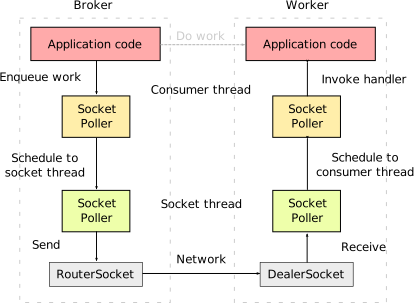
Interaction between threads and sockets
Heartbeat
In order for the communication to be robust and be able to detect failure and crash of either broker or (any) worker. The communicators implement a scheme called Paranoid Pirate Pattern. In this communication pattern, both sides periodically send messages back and forth essentially saying “I am alive” (these are generally called heartbeat messages). If one side does not receive such message for a certain period of time, e.g. three times the beat interval, then the other side is considered dead and/or unreachable.
Broker
The Broker class wraps the BrokerConnector and implements simple loadload distribution based
on the capabilities of the workers (i.e. based on the games the workers support). Through its
interface, the rest of the server can schedule jobs to be executed on the worker machines without
needing any more specific knowledge about workers.
Threading model
All public methods on the Broker class should use the Schedule helper method so that the
actual code executes on the consumer thread of the worker to avoid the need for locks and other
synchronization. Private methods can be executed only on the consumer thread by design and no
further scheduling is needed.
Load balancing
The broker keeps a queue of jobs sorted by the time the job was enqueued for execution by the server code. When a worker is available, a task is chosen such that it is the oldest enqueued job for a game that the worker is capable of executing. In case of a worker crashes while executing a job, the job is put back to work queue and can be later scheduled for execution on a different worker.
Worker
Situation is on the worker component side is very similar to the broker. The Broker class uses
WorkerConnector as a means to receive requests from the server and send responses once the tasks
are finished.